


2026.04.02
Flavescence Dorée – What Does the Vineyard Tell Us?
Flavescence dorée is a phytoplasma disease that gradually weakens grapevines and can significantly reduce yield. The infection is transmitted by the leafhopper, which allows the disease to spread unnoticed among vineyards. It has appeared in several wine regions in Hungary, making early detection and continuous monitoring of vineyards essential.

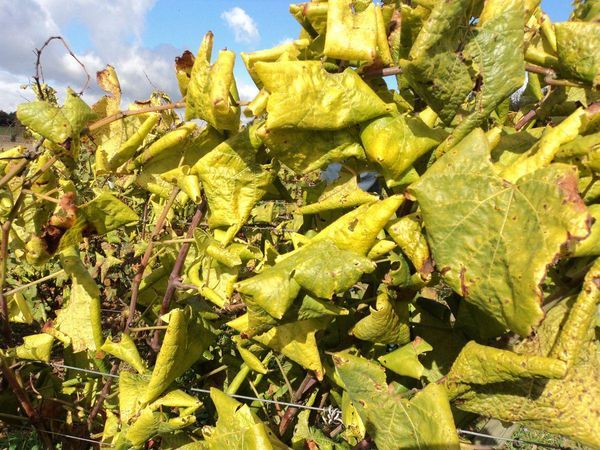
Flavescence dorée (Flavescence dorée) is currently one of the most serious grapevine diseases in Europe and has appeared in multiple wine regions in Hungary in recent years. The disease is caused by a unique pathogen known as a phytoplasma. Phytoplasmas are tiny, cell wall–less, bacteria-like organisms that inhabit the plant’s phloem tissue. There, they live, reproduce, and disrupt the system through which the vine transports sugars and nutrients. As a result, the infected plant gradually weakens, leaves turn yellow, grape cluster development slows, and yields may decrease by 20–50 %. Phytoplasmas cannot spread on their own, which makes the disease particularly insidious. Infection is transmitted by an insect vector, the leafhopper Scaphoideus titanus, which acquires the phytoplasma from an infected plant and transmits it to healthy vines while feeding. This creates a chain reaction of disease propagation within the vineyard. Managing the disease is especially challenging because there is no pesticide or remedy that
directly kills phytoplasmas within the plant. Phytoplasmas reside inside the plant where most treatments cannot reach them effectively. Therefore, control strategies are complex: simply removing infected vines is necessary but insufficient. Targeted treatments against the insect vector and the use of healthy, certified propagation material when planting are also essential.
Monitoring and controlling leafhopper populations and activity is crucial, as infection can easily reappear among vines. In Hungary, the phytoplasma causing flavescence dorée was first detected in Zala County in August 2013 and subsequently appeared in other wine regions. In some areas, infection has
been identified in multiple counties and wine regions, indicating that the disease’s spread is not localized and represents an ongoing risk for vineyards.
Symptoms are not always obvious at first: leaf yellowing, asymmetric shoot growth, weakening of clusters, and leaf curling develop gradually, often from mid-summer to autumn. This makes the disease particularly stealthy, as it is often only recognized when vines are already significantly affected. For grape growers, the key lesson is that early detection and management are critical. Late recognition, combined with inadequate control measures, can lead to vine death and severe yield losses within a few years. While phytoplasmas are not harmful to human health, they pose significant economic and production risks, making cooperation between authorities and growers vital for prevention and control.
References
NÉBIH – Official information on flavescence dorée in Hungary (phytoplasma, vector, spread)
Agro BASF – Overview of phytoplasma and plant health background
Bene et al. (2025) – Flavescence Dorée and Grapevine Susceptibility: From Host Pathogen Interaction to Cultivar Categorization
Pierro et al. (2024) – Genetic diversity of phytoplasmas associated with flavescence dorée at vineyard scale on the Ischia Island (Campania, Italy)