


2026.04.02
Cyclicality – How the Vine Awakens?
Grapevines operate cyclically, awakening each spring as buds unfold into green shoots. Precise pruning helps the vine focus on buds that will produce abundant and high-quality fruit. In spring, attentive growers support the plant’s development and the start of the new cycle.

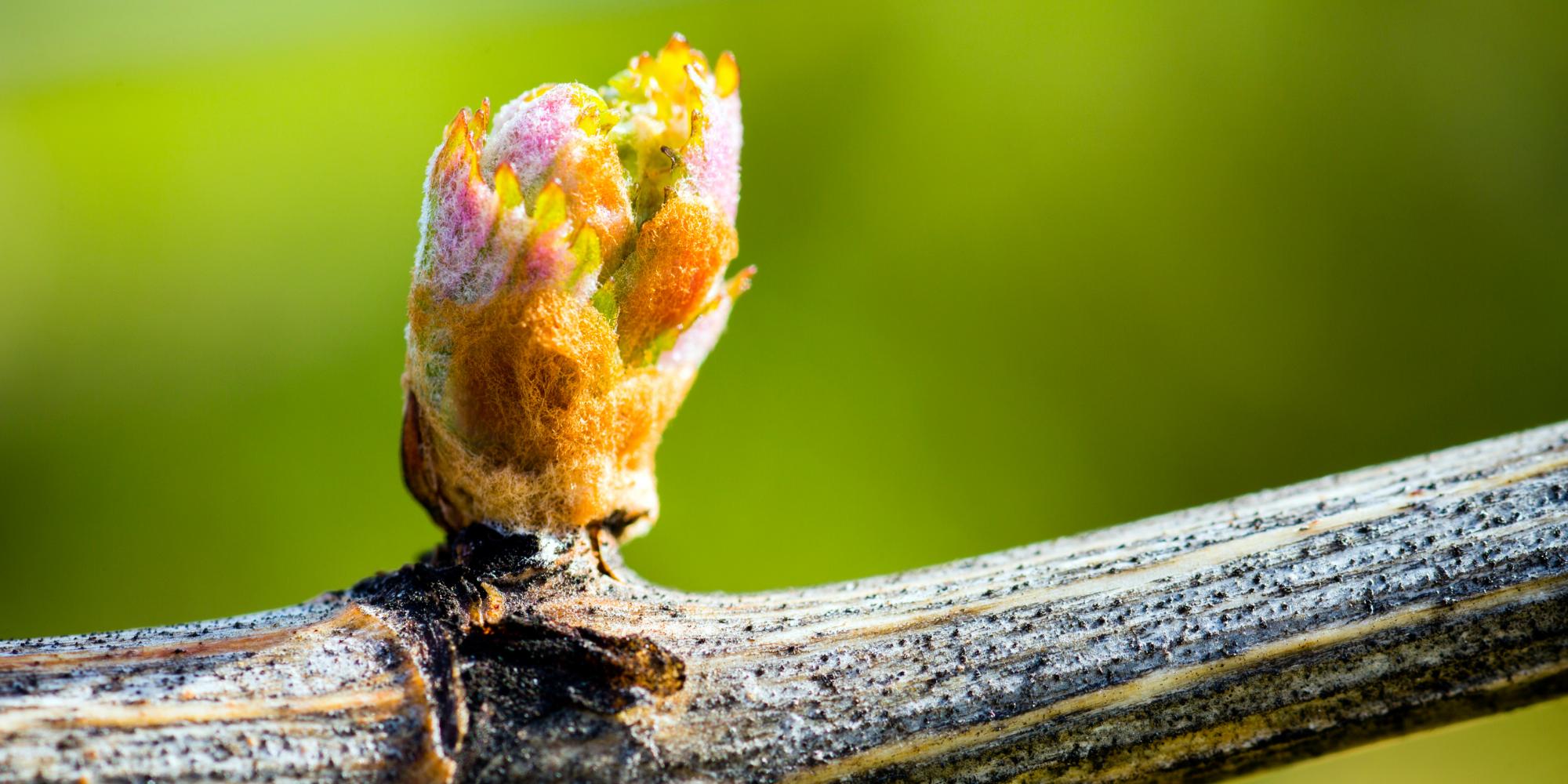
The vine’s life cycle is an annual repeating process: it begins with a cold winter dormancy, followed by an active growth period and fruit production. In the literature, winter dormancy is called dormancy or bud rest. This is a physiological state in which internal growth of the buds ceases, even if external temperatures are mild. Dormancy allows the plant to delay growth
until favorable conditions appear, reducing the risk of frost damage. Dormancy consists of two phases: endodormancy, when the bud is internally dormant due to biological factors, and ecodormancy, when external conditions, mainly temperature, regulate growth. For buds to “wake up” in spring, two temperature conditions must be met. First, buds need a sufficient accumulation of cold hours to break endodormancy, generally requiring exposure to 0–7 °C for a certain period. After this, the spring warming triggers growth: when daily average temperatures consistently rise to around 10–12 °C, metabolic activity in the buds resumes, leading to budburst. The exact threshold depends on the variety and local climate, but this range is typical for most European vineyards.
Budburst marks the first visible green shoot tips from the bud — one of the most critical moments in the vine’s life cycle. The plant shifts to vegetative growth, activating stored nutrients, accelerating sap flow, and producing photosynthetically active green tissue. From this point, the vine actively supports growth and future fruit production.
Why pruning matters?
Pruning serves as a load management tool. A vine has many buds, but only some should develop into shoots — those in favorable positions likely to yield good clusters. During pruning, unwanted buds are removed so the vine’s energy is focused on the remaining buds’ growth and cluster formation. Too many buds can disperse the vine’s energy, leading to weak shoots, loose clusters, and lower quality. Too few buds can reduce yield and hinder sustainable development. One approach is calculating pruning ratios relative to vine size and condition to ensure optimal shoot numbers at the start of the growing season. After budburst, the vine continuously increases hotosynthetic activity. Green leaves capture light and produce carbohydrates, which the vine uses to grow shoots, form inflorescences, and ripen berries. Vegetative growth and flowering progress in parallel during spring, steadily increasing energy use. Growers must also manage soil cultivation, nutrient supply, and pathogen protection to support healthy development. Monitoring soil moisture and nutrient levels post-pruning ensures new shoots grow rapidly and evenly.
References
Linsley-Noakes, G.C., & Allan, P. (1994). Comparison of models predicting budburst of grapevines (Vitis vinifera L.) in different climates. Journal of Horticultural Science, 69(3), 347–359.
Camargo-A, A., et al. (2022). The effect of temperature thresholds on grapevine phenology. Scientia Horticulturae, 292, 110634.
Piña-Rey, A., et al. (2022). Phenological model to predict budbreak and flowering dates of Vitis vinifera. Plants, 10(3), 502.